From documentation to claim readiness
mutim connects clinical documentation with ICD-10-AM and SBS coding, checks each prior authorization before it is sent and prepares the claim for submission. Your staff review each one.
Right knee pain for 6 weeks after a twisting injury. McMurray test positive. Assessment: tear of the medial meniscus. Plan: MRI of the right knee without contrast.
- Active on the date of service
- Coded to the last character
- Side stated in the note
- A sentence behind every code
Coding support
ICD-10-AM and SBS codes suggested from the note, each with the words it came from.
Clinical documentation improvement
Missing or unclear details named for the clinician to settle before the claim goes.
Prior authorization
Authorization needs detected, medical necessity checked against the payer’s rules, and the request submitted after review.
Nothing is submitted until a named person has reviewed it.
Two steps after the note is signed
Medical coding with the sentence behind every code
The signed note is coded to ICD-10-AM, ACHI and SBS from the official tables. Fixed rules check each code, an unspecified one becomes a question for the clinician, and your coder accepts or rejects it.
Medical coding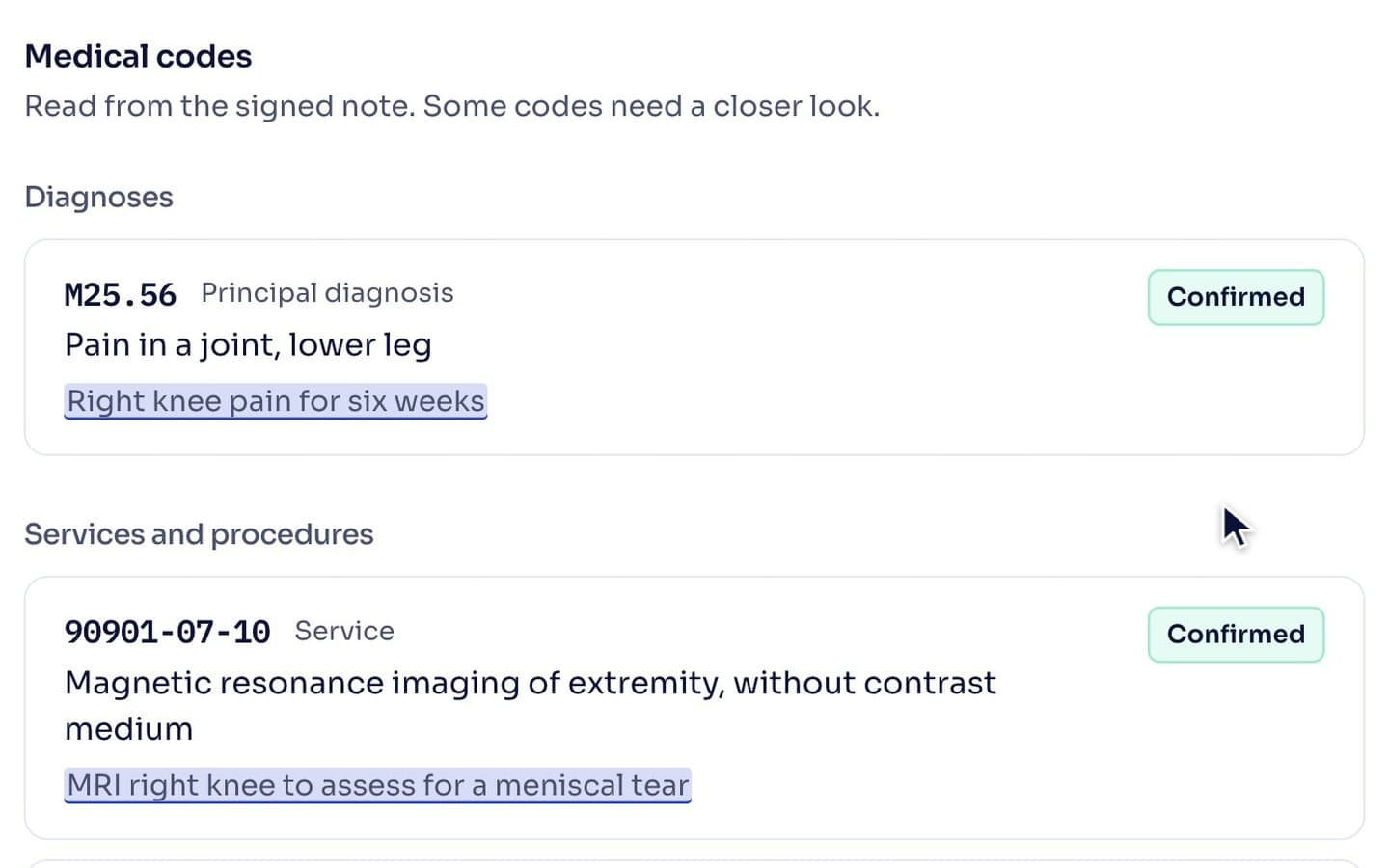
Prior authorization and claims, checked before they are sent
Each request is checked against the payer’s rules, the patient’s coverage and the NPHIES format, and a named person approves it before it goes.
Prior authorization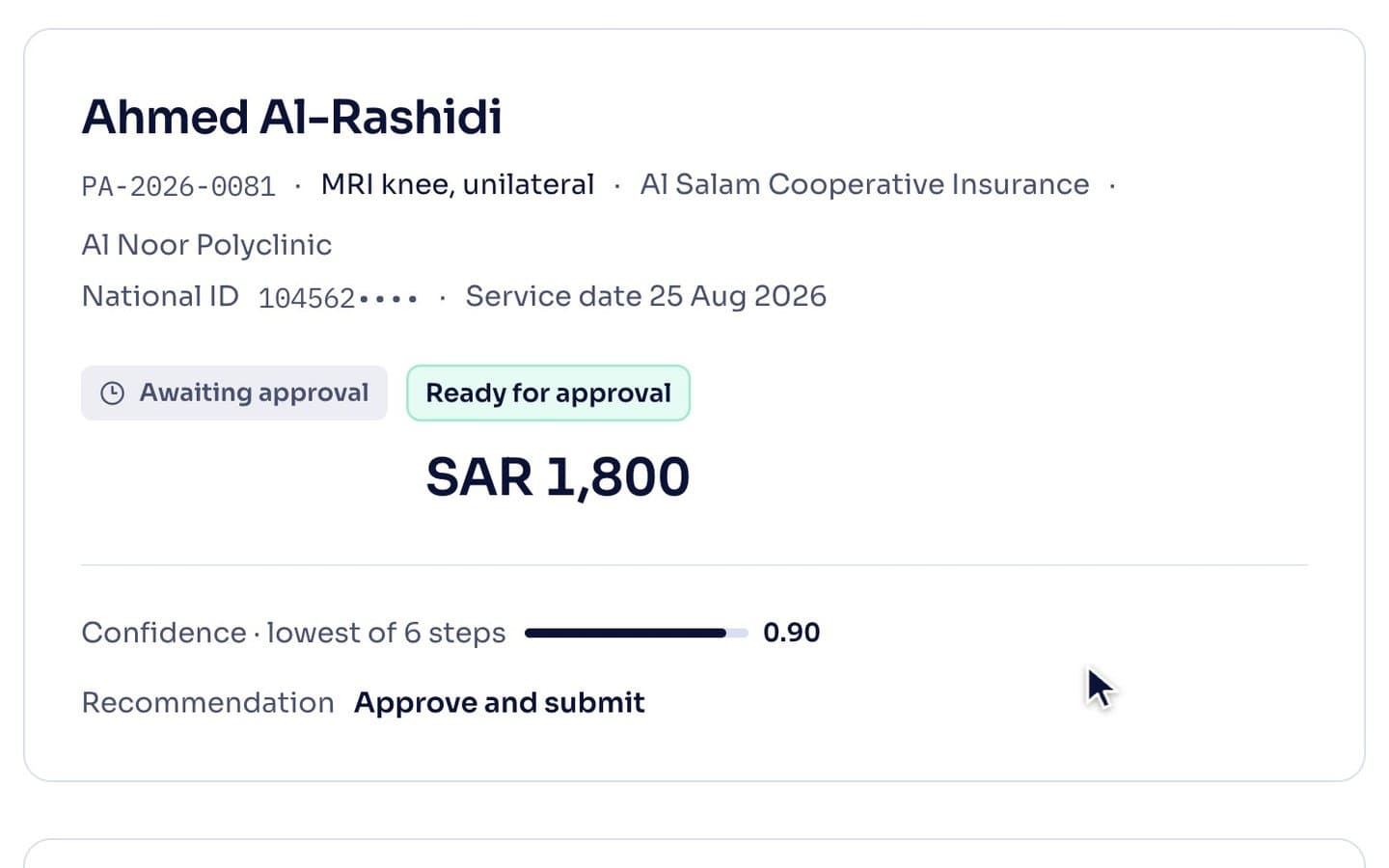
What published Saudi studies found
26.8% of principal diagnoses were coded wrongly in a re-coding study at a hospital in Najran.
Albagmi, F1000Research, 202431% of the claimed value changed when those records were re-coded: SAR 12,927 of SAR 42,333.
Albagmi, F1000Research, 202493.6% of 1,117 denied claims reviewed at a Saudi academic medical centre were outpatient.
Al-Kahtani et al., Insurance Markets and Companies, 2025Independent published studies. These are not mutim results.
Why requests come back rejected
A review of denied claims at a Saudi academic medical centre named three main causes. A coding study adds a fourth. Each can be caught before a request is sent.
- DeniedAsked for before sending
Missing medical data
mutim lists what the payer needs for this service and names what the note does not say yet.
- DeniedCoverage checked first
Condition not covered
Eligibility and remaining benefit are checked when the patient arrives, before anyone drafts a request.
- DeniedValidated for NPHIES
System and format errors
Every request is validated against the NPHIES format before it leaves your facility.
- DeniedCode tied to the note
Wrong diagnosis code
Each code shows the sentence of the clinical note it came from, so a reviewer can check it at a glance.
Causes from Al-Kahtani et al. (2025) and Albagmi (2024).
See what rejected requests cost you
Three numbers from your own facility. The full method is on the calculator page.
Assumes your rejection rate falls to 10% with mutim. That is an assumption, not a measured result.
Open the full calculatorOne portal for the whole encounter
Ambient workflow
In the consultation
Turns the conversation into draft notes, orders and follow-up, for the clinician to approve.
Clinical intelligence
At the decision
Clinical reasoning and decision support, from the patient’s record and the evidence.
Revenue cycle intelligence
You are here
Supports coding, CDI, prior authorization and claim readiness.